UNITED STATES
SECURITIES AND EXCHANGE COMMISSION
WASHINGTON, DC 20549


FORM 8-K
CURRENT REPORT
Pursuant to Section 13 or 15(d) of the
Securities Exchange Act of 1934
 
Date of Report (Date of Earliest Event Reported):  March 19, 2026

LINCOLN EDUCATIONAL SERVICES CORPORATION

(Exact Name of Registrant as Specified in Charter)

New Jersey
 
000-51371
 
57-1150621
         
         
(State or Other Jurisdiction of Incorporation)
 
(Commission File Number)
 
(IRS Employer Identification No.)
 
14 Sylvan Way, Suite A, Parsippany, NJ 07054

(Address of Principal Executive Offices)   (Zip Code)

Registrant’s telephone number, including area code: (973) 736-9340

Not applicable
(Former name or former address, if changed since last report)

Check the appropriate box below if the Form 8-K filing is intended to simultaneously satisfy the filing obligation of the registrant under any of the following provisions:
 

Written communications pursuant to Rule 425 under the Securities Act (17 CFR 230.425)
 

Soliciting material pursuant to Rule 14a-12 under the Exchange Act (17 CFR 240.14a-12)
 

Pre-commencement communications pursuant to Rule 14d-2(b) under the Exchange Act (17 CFR 240.14d-2(b))
 

Pre-commencement communications pursuant to Rule 13e-4(c) under the Exchange Act (17 CFR 240.13e-4(c))
 
Securities registered pursuant to Section 12(b) of the Act:
 
     
Title of each class
Trading
Symbol(s)
Name of each exchange on which
registered
Common Stock No Par Value
LINC
NASDAQ

Indicate by check mark whether the registrant is an emerging growth company as defined in Rule 405 of the Securities Act of 1933 (§230.405 of this chapter) or Rule 12b-2 of the Securities Exchange Act of 1934  (§240.12b-2 of this chapter).
Emerging growth company
 
If an emerging growth company, indicate by check mark if the registrant has elected not to use the extended transition period for complying with any new or revised financial accounting standards provided pursuant to Section 13(a) of the Exchange Act.          ☐


Item 7.01.
Regulation FD Disclosure.

On March 19, 2026, Lincoln Educational Services Corporation (the “Company”) hosted an Investor Day. The Company issued a press release related to the Investor Day on the same date, a copy of which is furnished as Exhibit 99.1 to this Current Report on Form 8-K and incorporated by reference into this Item 7.01.

As previously announced, a live webcast and a presentation will be available at  Lincoln’s website at https://investorday.lincolneducationalservices.com  and a replay of the webcast will be available for 90 days following the event at lincolntech.edu. These materials are included as Exhibit 99.1 and Exhibit 99.2 to this Current Report on Form 8-K and are incorporated by reference into this Item 7.01.

The information in this Item 7.01, including Exhibits 99.1 and 99.2, is being furnished and shall not be deemed to be “filed” for purposes of Section 18 of the Securities Exchange Act of 1934, as amended, or otherwise subject to the liabilities of that Section and shall not be deemed incorporated by reference into any registration statement or other document filed pursuant to the Securities Act of 1933, as amended, except as shall be expressly set forth by specific reference in such filing.

A copy of the press release and Investor Day Presentation issued by the Company on March 19, 2026, is furnished as Exhibit 99.1 and  99.2 to this Current Report on Form 8-K and is incorporated in this Item 7.01 by reference.

Item 9.01
Financial Statements and Exhibits.

(d)
Exhibits.

Exhibit No.
Exhibit Title
Press Release, dated March 19, 2026, issued by Lincoln Educational Services Corporation as to the Investor Day.
   
Investor Day Presentation
   
104
Cover Page Interactive Data File (embedded within the inline XBRL document).


SIGNATURES

Pursuant to the requirements of the Securities Exchange Act of 1934, the registrant has duly caused this report to be signed on its behalf by the undersigned hereunto duly authorized.

 
LINCOLN EDUCATIONAL SERVICES CORPORATION
     
Date:  March 19, 2026


By:
/s/ Brian K. Meyers
 
 
Name: Brian K. Meyers
 
Title:   Executive Vice President, Chief Financial Officer  and Treasurer


Exhibit 99.1

Lincoln Educational Services Reviews Strategic Growth Initiatives and Long-Term Financial Targets During Investor Day; First Quarter 2026 Student Start Growth Expected to Rise 19%

Company Provides Five Year Outlook for Financial Performance

Live Video Webcast of Investor Day Presentations Begins at 11:00 a.m. ET
 
PARSIPPANY, N.J., March 19, 2026 – Lincoln Educational Services Corporation (Nasdaq: LINC) is hosting its 2026 Investor Day at 11:00am ET today at its Nashville, TN campus, and via a live video webcast. Scott Shaw, CEO and President and other members of senior management will review the Company’s strategic priorities, growth initiatives and financial performance objectives through 2030.

“Our first quarter momentum is demonstrating the same positive student start trends we have experienced over the previous 13 quarters, and we now anticipate student start growth to increase 19% compared to the year-ago first quarter,” commented Mr. Shaw. “America’s continuing skills gap and the growing interest in learning skilled trades along with our strategic initiatives have positioned Lincoln for consistent, continued growth over the next five years. We look forward to reviewing our plans with investors and analysts at our new, state of the art Nashville campus today.”

To access the video webcast of the Investor Day, participants are requested to register in advance, or at a minimum, 15 minutes before the start of the presentations, at https://investorday.lincolneducationalservices.com.  Once completed, an email confirming your registration will be sent and will allow you to access the video webcast. The agenda and speakers, along with slides presented during the Investor Day, will also be available via the website. A replay of the Investor Day will also be available after the event via lincolntech.edu. Due to limited capacity, in-person attendance is available by invitation only.

ABOUT LINCOLN EDUCATIONAL SERVICES CORPORATION

Lincoln Educational Services Corporation is a leading provider of diversified career-oriented postsecondary education. Lincoln offers recent high school graduates and working adults career-oriented programs in skilled trades, automotive technology, health sciences and information technology. Lincoln has provided the workforce with skilled technicians since its inception in 1946.

Lincoln currently operates 22 campuses in 12 states under 3 brands: Lincoln College of Technology, Lincoln Technical Institute and Nashville Auto Diesel College. For more information, go to www.lincolntech.edu.

1

FORWARD-LOOKING STATEMENTS

Statements in this press release and in oral statements made from time to time by representatives of Lincoln Educational Services Corporation that are not historical facts, including those made in a conference call, may be “forward-looking statements” as that term is defined in the federal securities laws. The words “may,” “will,” “expect,” “believe,” “anticipate,” “project,” “plan,” “intend,” “estimate,” “goal,” “target” and “continue,” and similar expressions and their opposite are intended to identify forward-looking statements. Forward-looking statements should not be read as a guarantee of future performance or results and will not necessarily be accurate indications of the times at, or by, which such performance or results will be achieved, if at all. The Company cautions you that these statements concern current expectations about the Company’s future performance or events and are subject to a number of uncertainties, risks, and other influences, many of which are beyond the Company’s control, that may affect the accuracy of the statements or the prospects upon which the statements are based including, without limitation, risks associated with our ability to comply with the extensive federal and state regulatory framework applicable to the for-profit education industry such as the 90/10 rule, prescribed cohort default rates, the effect of current and future Title IV Program regulations arising out of negotiated rulemakings, including any potential reductions in funding or restrictions on the use of funds received through Title IV Programs and financial responsibility and administrative capability standards; the effect of future legislative or regulatory initiatives related to veterans' benefit programs; our ability to obtain timely regulatory approvals in connection with acquisitions of additional schools and the related risks associated with integration of acquired schools; risks associated with the opening of new campuses; our ability to execute our growth strategies including updating and expanding the content of existing programs and developing new programs for our students in a timely and cost-effective manner while maintaining positive student outcomes; our ability to effectively compete within our industry; impacts related to epidemics or pandemics; risks associated with cybersecurity; general economic conditions; and other factors discussed in the “Risk Factors” section of our Annual Reports and Quarterly Reports filed with the Securities and Exchange Commission. All forward-looking statements are qualified in their entirety by this cautionary statement, and Lincoln undertakes no obligation to publicly revise or update any forward-looking statements, whether as a result of new information, future events or otherwise after the date hereof.
 
LINCOLN EDUCATIONAL SERVICES CORPORATION
Brian Meyers, CFO
973-736-9340

EVC GROUP LLC
Michael Polyviou
mpolyviou@evcgroup.com
732-933-2754


2


Exhibit 99.2
 PRESENTED BY: SCOTT SHAW  Chief Executive Officer and President  March 19, 2026 
 

 Safe Harbor Statement  Statements contained in this presentation regarding Lincoln’s business that are not historical facts may be “forward-looking statements” within the meaning of the safe harbor from civil liability provided for such statements by the Private Securities Litigation Reform Act of 1995 (set forth in Section 27A of the Securities Act of 1933, as amended, and Section 21E of the Securities Exchange Act of 1934, as amended). The words “may,” “will,” “expect,” “believe,” “anticipate,” “project,” “plan,” “goal,” “target,” “intend,” and “estimate” and their opposites and similar expressions are intended to identify forward-looking statements. Forward-looking statements are based on information available at the time that the statements are made and/or management’s good faith belief as of that time with respect to future events, many of which are beyond the Company’s control, and are subject to risks and uncertainties that could cause actual performance or results to differ materially from those expressed in or suggested by the forward-looking statements. While we believe that the expectations reflected in the forward-looking statements are reasonable, we cannot guarantee future results, levels of activity, performance, achievements or that events and circumstances reflected in the forward-looking statements will occur and, as such, forward-looking statements should not be read as a guarantee of future performance or results and will not necessarily be accurate indications of the times at, or by, which such performance or results will be achieved, if at all. All forward-looking statements are qualified in their entirety by this cautionary statement  Generally, forward-looking statements relate to business plans or strategies and projections involving anticipated revenues, earnings, or other aspects of the Company’s operating results. The Company cautions that these statements are subject to a number of uncertainties, risks, and other factors, that may influence the accuracy of the statements or the circumstances upon which the statements are based including, without limitation, uncertainties related to our ability to comply with the existing and future federal and state regulatory framework applicable to our industry; our failure to maintain eligibility for or our ability to process federal student financial assistance funds; the effect of current and future Title IV Program regulations, including any potential reductions in funding or restrictions on the use of funds received through Title IV Programs; the effect of current and future legislative or regulatory initiatives related to veterans’ benefit programs; continued Congressional examination of the for-profit education sector; investigations of, or actions commenced against, us or other companies in our industry; changes in the state regulatory environment or budgetary constraints; our inability to successfully formulate and implement a growth and diversification strategy, including effectively identifying, establishing and operating additional schools, programs or campuses; our success in updating and expanding the content of existing programs and developing new programs for our students in a timely and cost-effective manner while maintaining positive student outcomes; risks associated with the opening of new campuses; our failure to obtain timely regulatory approvals in connection with acquisitions or a change of control of our Company; risks associated with integration of acquired schools; enrollment declines or challenges in our students’ ability to find employment as a result of macroeconomic conditions; industry competition; risks associated with cybersecurity; our failure to maintain and expand existing industry relationships and develop new industry relationships; general economic conditions; and other factors discussed in the “Risk Factors” section of our Annual Reports and Quarterly Reports filed with the Securities and Exchange Commission incorporated by reference. Given these risks, uncertainties and other factors, you should not place undue reliance on these forward-looking statements. We make no representation as to the accuracy or completeness of these forward-looking statements and, except as required by law, we assume no obligation to update or revise these forward-looking statements publicly, even if new information becomes available in the future. 
 

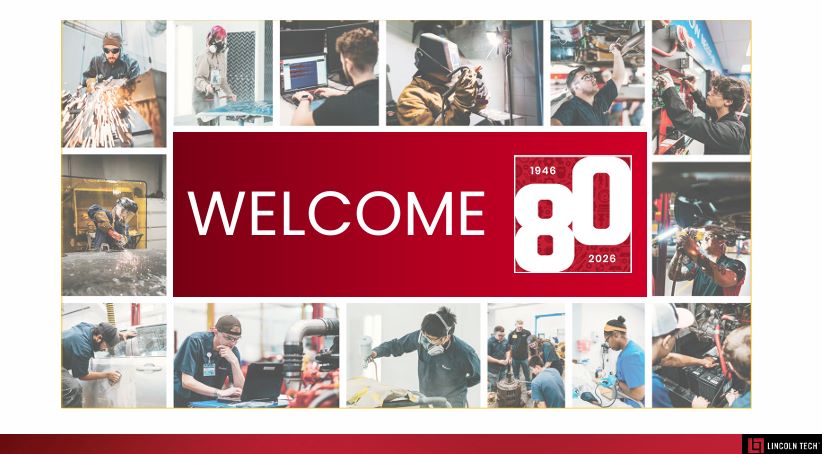
 WELCOME 
 

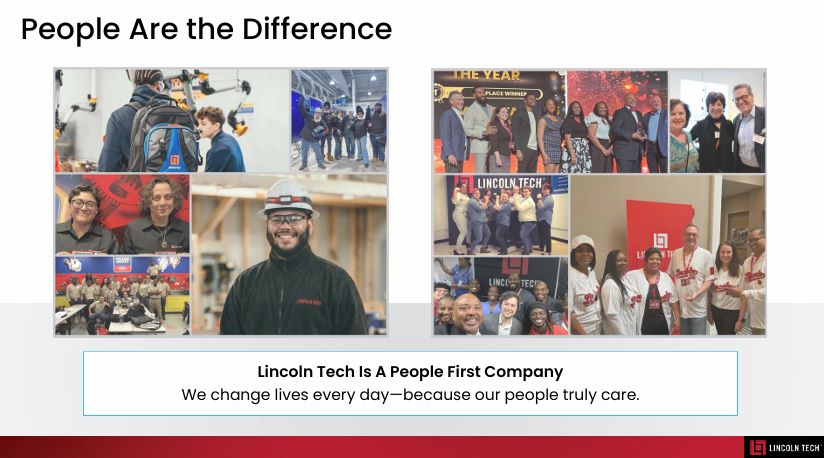
 People Are the Difference  Lincoln Tech Is A People First Company  We change lives every day—because our people truly care. 
 

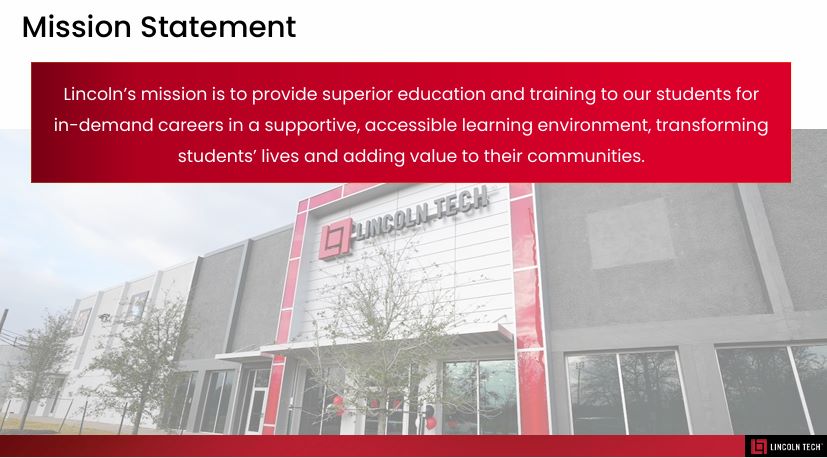
 Mission Statement  Lincoln’s mission is to provide superior education and training to our students for in-demand careers in a supportive, accessible learning environment, transforming students’ lives and adding value to their communities. 
 

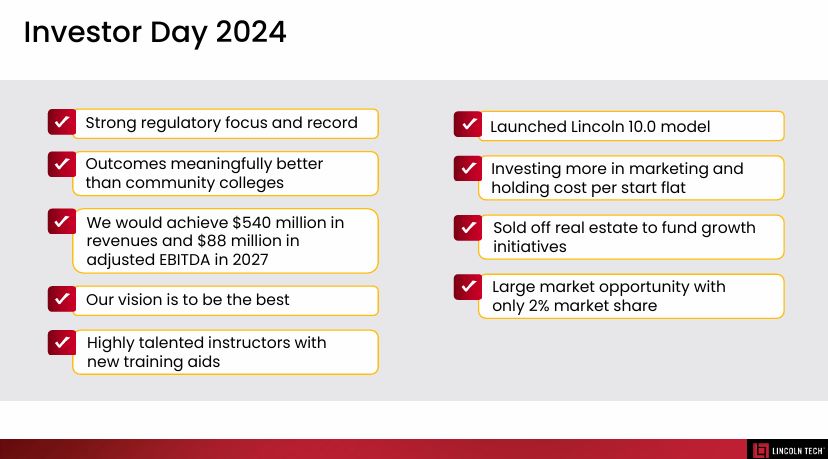
 Investor Day 2024  Strong regulatory focus and record  Outcomes meaningfully better than community colleges  We would achieve $540 million in revenues and $88 million in adjusted EBITDA in 2027  Our vision is to be the best  Large market opportunity with only 2% market share  Highly talented instructors with new training aids  Launched Lincoln 10.0 model  Investing more in marketing and holding cost per start flat  Sold off real estate to fund growth initiatives 
 

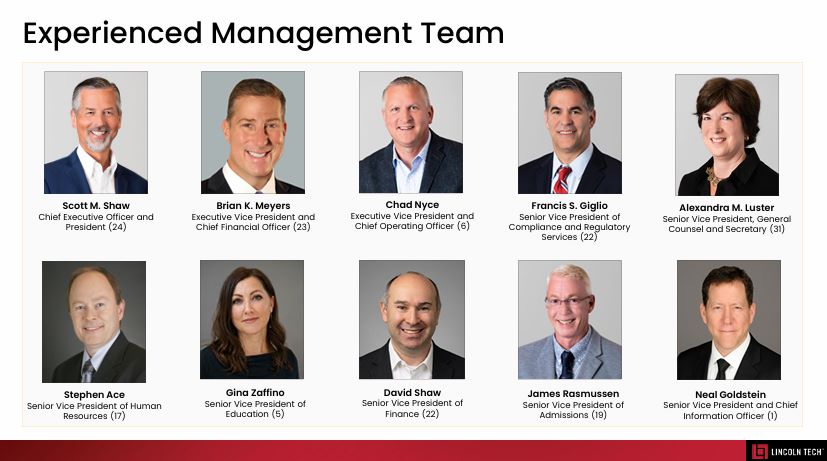
 Experienced Management Team  Scott M. Shaw  Chief Executive Officer and President (24)  Brian K. Meyers Executive Vice President and Chief Financial Officer (23)  Chad Nyce Executive Vice President and Chief Operating Officer (6)  Stephen Ace  Senior Vice President of Human Resources (17)  Francis S. Giglio  Senior Vice President of Compliance and Regulatory Services (22)  Alexandra M. Luster  Senior Vice President, General Counsel and Secretary (31)  James Rasmussen Senior Vice President of Admissions (19)  Neal Goldstein  Senior Vice President and Chief Information Officer (1)  David Shaw  Senior Vice President of Finance (22)  Gina Zaffino  Senior Vice President of Education (5) 
 

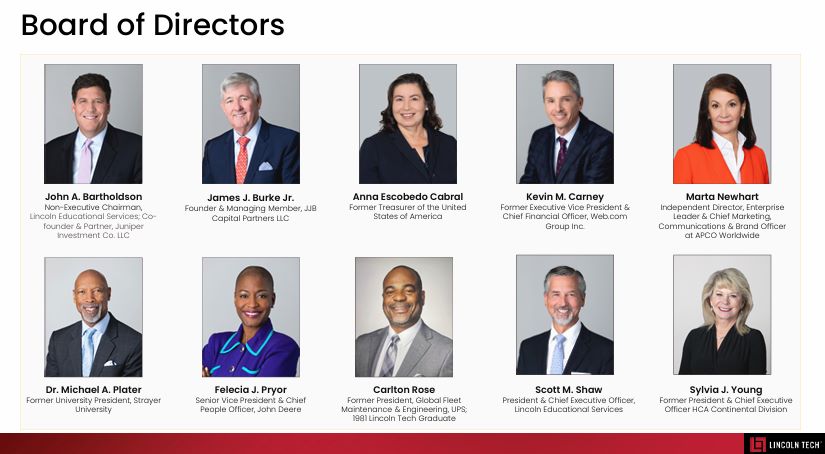
 Board of Directors  John A. Bartholdson  Non-Executive Chairman, Lincoln Educational Services; Co-  founder & Partner, Juniper Investment Co. LLC  James J. Burke Jr.  Founder & Managing Member, JJB Capital Partners LLC  Anna Escobedo Cabral Former Treasurer of the United States of America  Kevin M. Carney Former Executive Vice President & Chief Financial Officer, Web.com  Group Inc.  Marta Newhart Independent Director, Enterprise Leader & Chief Marketing,  Communications & Brand Officer at APCO Worldwide  Dr. Michael A. Plater  Former University President, Strayer University  Felecia J. Pryor  Senior Vice President & Chief People Officer, John Deere  Carlton Rose  Former President, Global Fleet Maintenance & Engineering, UPS; 1981 Lincoln Tech Graduate  Scott M. Shaw  President & Chief Executive Officer, Lincoln Educational Services  Sylvia J. Young  Former President & Chief Executive Officer HCA Continental Division 
 

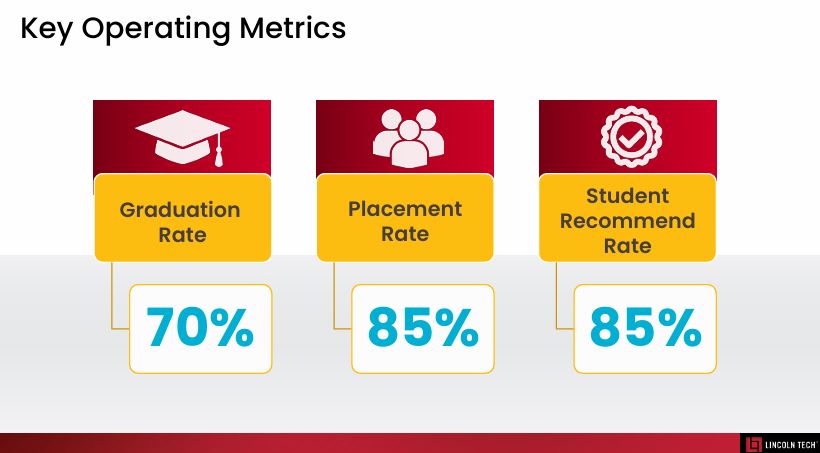
 70% 85% 85%  Key Operating Metrics  Graduation Rate  Placement Rate  Student  Recommend Rate 
 

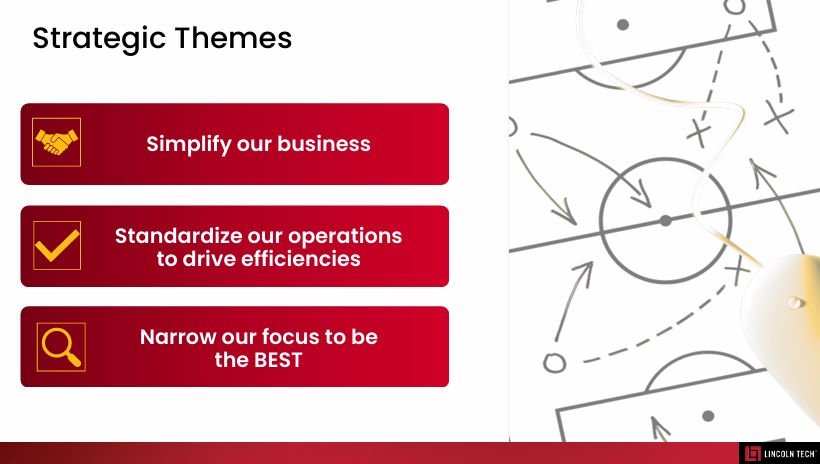
 Strategic Themes  Simplify our business  Standardize our operations to drive efficiencies  Narrow our focus to be the BEST 
 

 OUR OPPORTUNTIES HAVE NEVER BEEN BETTER  Q1 is off to a strong start, with starts up approximately 19–20%. 
 

 PRESENTED BY: Scott Watkins  Vice President of Marketing  March 19, 2026 
 

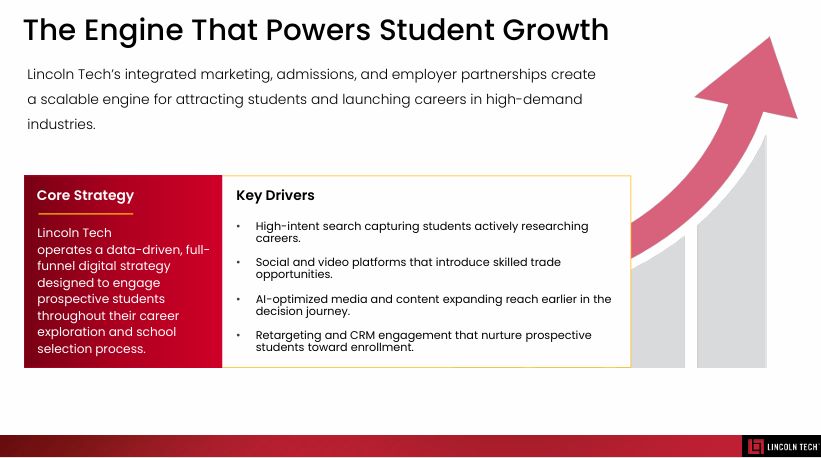
 The Engine That Powers Student Growth  Lincoln Tech’s integrated marketing, admissions, and employer partnerships create a scalable engine for attracting students and launching careers in high-demand industries.  Core Strategy  Key Drivers  High-intent search capturing students actively researching careers.  Social and video platforms that introduce skilled trade opportunities.  AI-optimized media and content expanding reach earlier in the decision journey.  Retargeting and CRM engagement that nurture prospective students toward enrollment.  Lincoln Tech  operates a data-driven, full-funnel digital strategy  designed to engage prospective students throughout their career exploration and school selection process. 
 

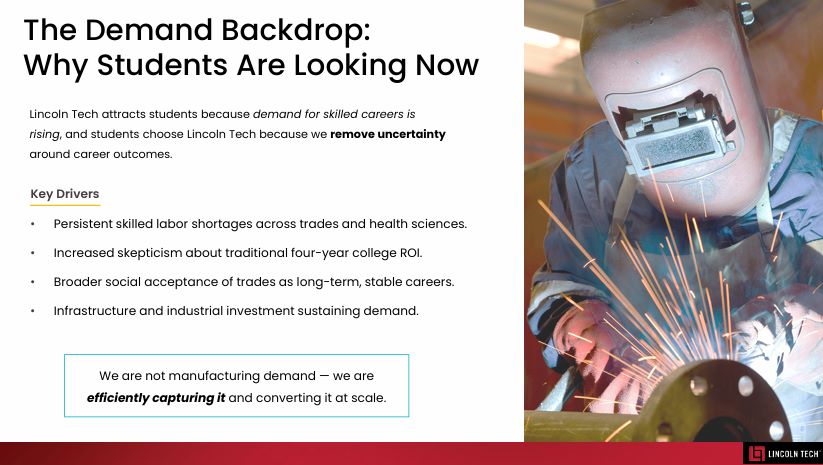
 The Demand Backdrop:  Why Students Are Looking Now  Lincoln Tech attracts students because demand for skilled careers is rising, and students choose Lincoln Tech because we remove uncertainty around career outcomes.  Key Drivers  Persistent skilled labor shortages across trades and health sciences.  Increased skepticism about traditional four-year college ROI.  Broader social acceptance of trades as long-term, stable careers.  Infrastructure and industrial investment sustaining demand.  We are not manufacturing demand — we are  efficiently capturing it and converting it at scale. 
 

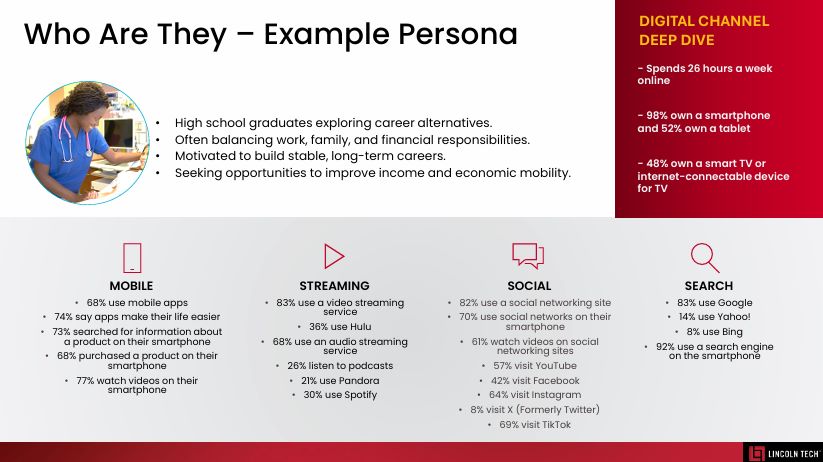
 Who Are They – Example Persona  High school graduates exploring career alternatives.  Often balancing work, family, and financial responsibilities.  Motivated to build stable, long-term careers.  Seeking opportunities to improve income and economic mobility.  SOCIAL  82% use a social networking site  70% use social networks on their  smartphone  61% watch videos on social networking sites  57% visit YouTube  42% visit Facebook  64% visit Instagram  8% visit X (Formerly Twitter)  69% visit TikTok  SEARCH  83% use Google  14% use Yahoo!  8% use Bing  92% use a search engine on the smartphone  MOBILE  68% use mobile apps  74% say apps make their life easier  73% searched for information about a product on their smartphone  68% purchased a product on their  smartphone  77% watch videos on their  smartphone  STREAMING  83% use a video streaming  service  36% use Hulu  68% use an audio streaming  service  26% listen to podcasts  21% use Pandora  30% use Spotify  DIGITAL CHANNEL DEEP DIVE  - Spends 26 hours a week online  - 98% own a smartphone and 52% own a tablet  - 48% own a smart TV or internet-connectable device for TV 
 

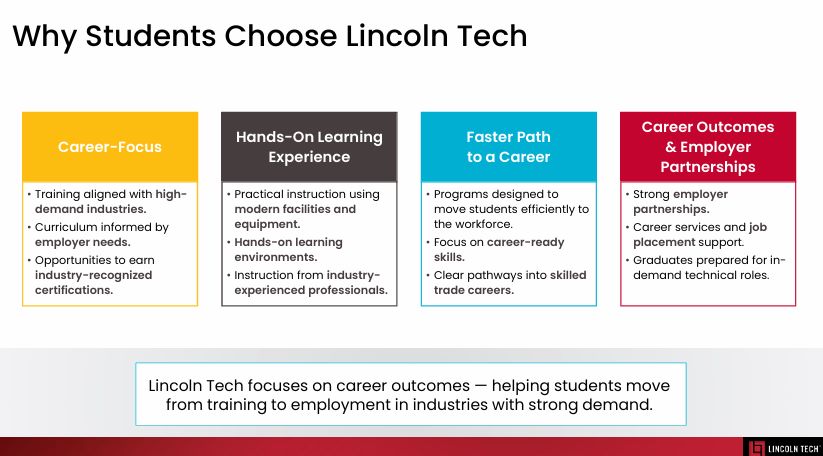
 Why Students Choose Lincoln Tech  Career-Focus  Training aligned with high-demand industries.  Curriculum informed by  employer needs.  Opportunities to earn industry-recognized certifications.  Hands-On Learning Experience  Practical instruction using modern facilities and equipment.  Hands-on learning environments.  Instruction from industry-experienced professionals.  Faster Path to a Career  Programs designed to move students efficiently to the workforce.  Focus on career-ready skills.  Clear pathways into skilled trade careers.  Career Outcomes & Employer Partnerships  Strong employer partnerships.  Career services and job placement support.  Graduates prepared for in-demand technical roles.  Lincoln Tech focuses on career outcomes — helping students move from training to employment in industries with strong demand. 
 

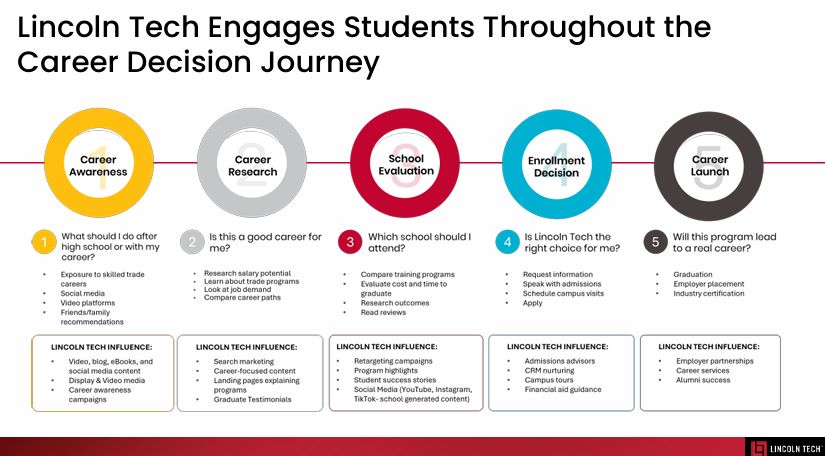
 Lincoln Tech Engages Students Throughout the Career Decision Journey 
 

 PRESENTED BY: Jay Rasmussen  Senior Vice President of Admissions  March 19, 2026 
 

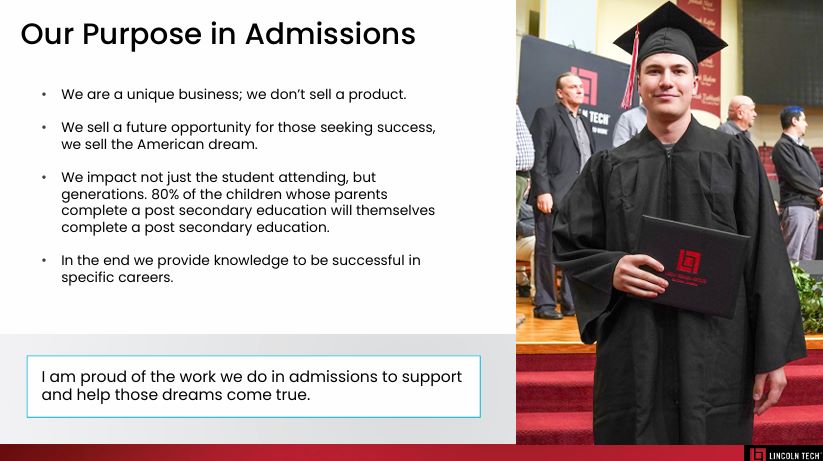
 Our Purpose in Admissions  We are a unique business; we don’t sell a product.  We sell a future opportunity for those seeking success, we sell the American dream.  We impact not just the student attending, but generations. 80% of the children whose parents complete a post secondary education will themselves complete a post secondary education.  In the end we provide knowledge to be successful in specific careers.  I am proud of the work we do in admissions to support and help those dreams come true. 
 

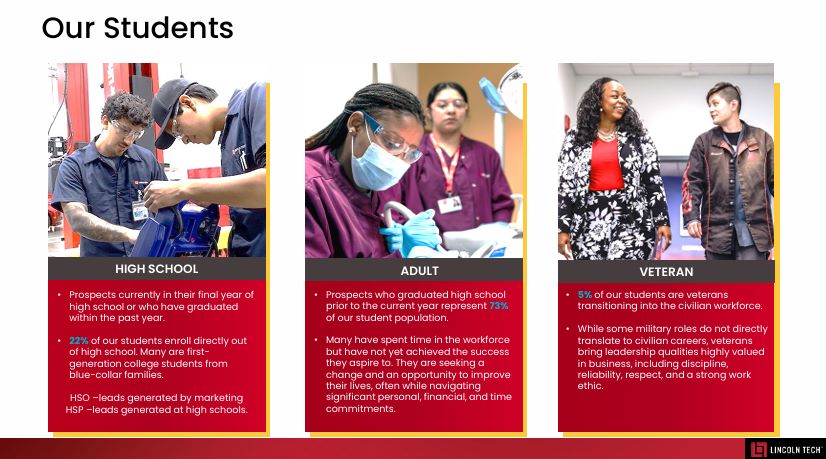
 Our Students  Prospects currently in their final year of high school or who have graduated within the past year.  22% of our students enroll directly out of high school. Many are first- generation college students from blue-collar families.  HSO –leads generated by marketing HSP –leads generated at high schools.  Prospects who graduated high school prior to the current year represent 73% of our student population.  Many have spent time in the workforce but have not yet achieved the success they aspire to. They are seeking a change and an opportunity to improve their lives, often while navigating significant personal, financial, and time commitments.  5% of our students are veterans transitioning into the civilian workforce.  While some military roles do not directly translate to civilian careers, veterans bring leadership qualities highly valued in business, including discipline, reliability, respect, and a strong work ethic.  HIGH SCHOOL  ADULT  VETERAN 
 

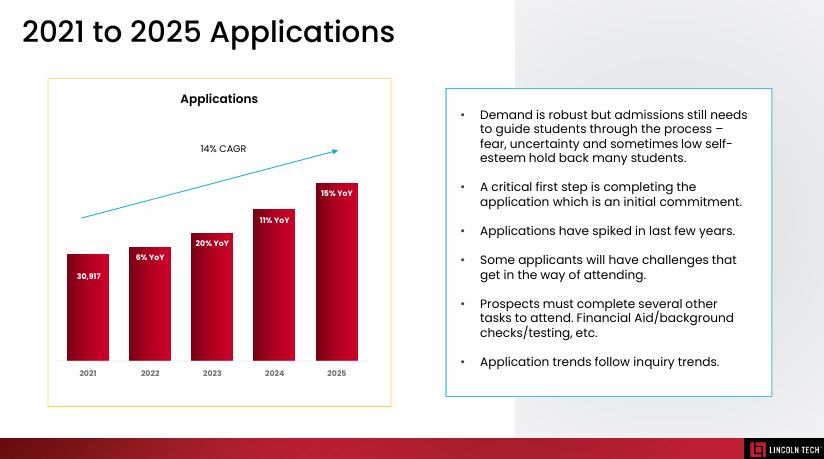
 2021 to 2025 Applications  30,917  6% YoY  20% YoY  11% YoY  15% YoY  2021  2022  2023  2024  2025  Enrollments  14% CAGR  Demand is robust but admissions still needs to guide students through the process – fear, uncertainty and sometimes low self-esteem hold back many students.  A critical first step is completing the application which is an initial commitment.  Applications have spiked in last few years.  Some applicants will have challenges that get in the way of attending.  Prospects must complete several other tasks to attend. Financial Aid/background checks/testing, etc.  Application trends follow inquiry trends.  Applications 
 

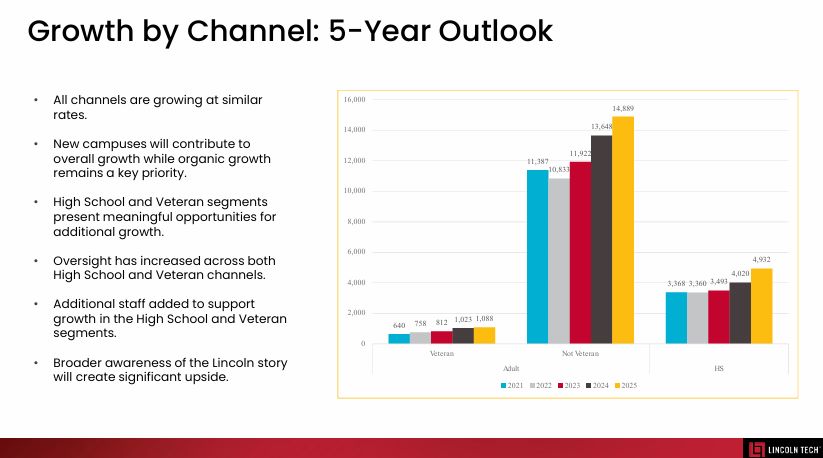
 Growth by Channel: 5-Year Outlook  640  11,387  758  10,833  812  11,922  3,368 3,360 3,493   13,648  4,020  1,023 1,088  14,889  4,932  0  2,000  4,000  6,000  8,000  10,000  12,000  14,000  16,000  Veteran  Not Veteran  Adult  HS  2021 2022 2023 2024 2025  All channels are growing at similar rates.  New campuses will contribute to overall growth while organic growth remains a key priority.  High School and Veteran segments present meaningful opportunities for additional growth.  Oversight has increased across both High School and Veteran channels.  Additional staff added to support growth in the High School and Veteran segments.  Broader awareness of the Lincoln story will create significant upside. 
 

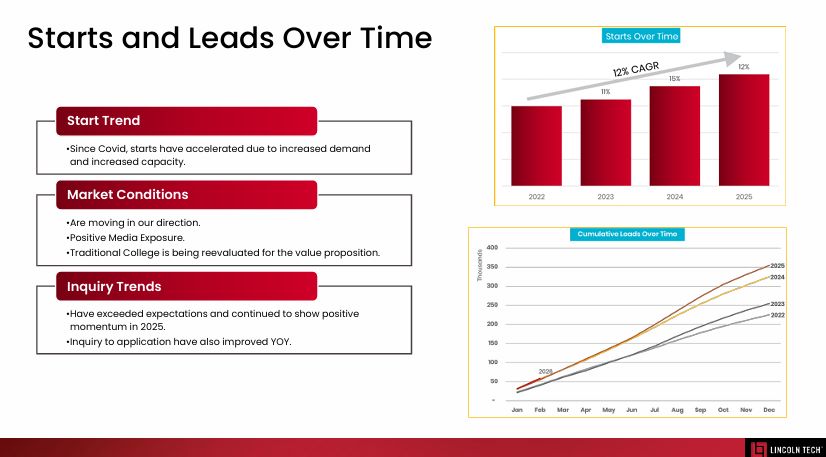
 Starts and Leads Over Time  Start Trend  Since Covid, starts have accelerated due to increased demand and increased capacity.  Market Conditions  Are moving in our direction.  Positive Media Exposure.  Traditional College is being reevaluated for the value proposition.  Inquiry Trends  Have exceeded expectations and continued to show positive momentum in 2025.  Inquiry to application have also improved YOY. 
 

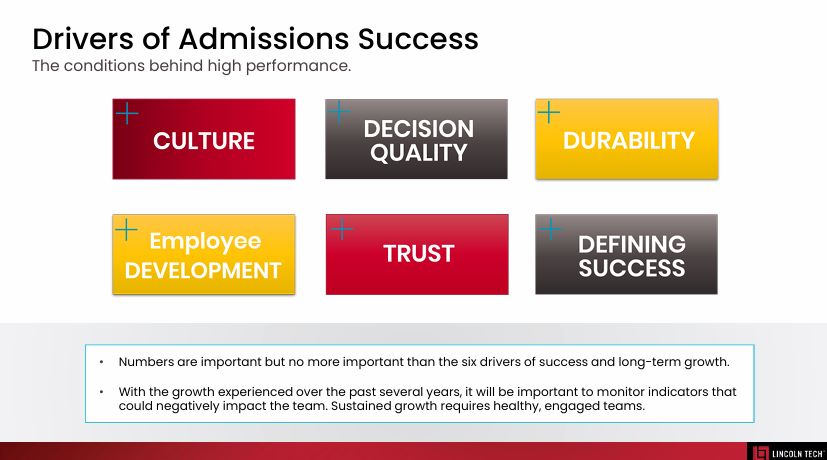
 Drivers of Admissions Success  The conditions behind high performance.  Numbers are important but no more important than the six drivers of success and long-term growth.  With the growth experienced over the past several years, it will be important to monitor indicators that could negatively impact the team. Sustained growth requires healthy, engaged teams. 
 

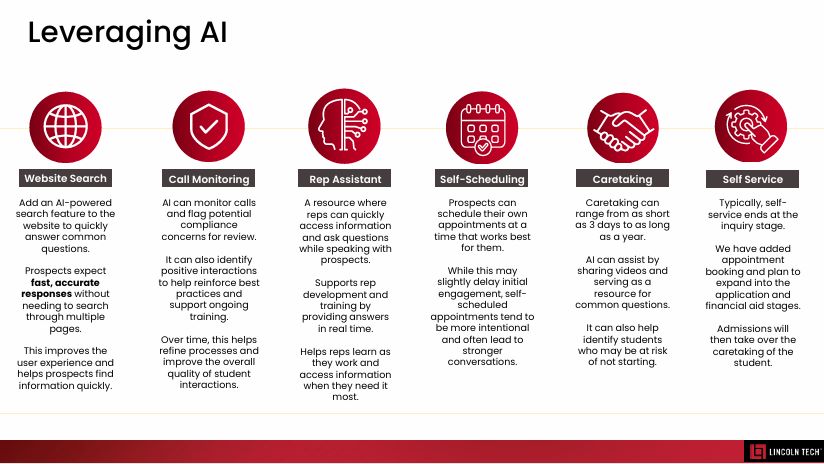
 Caretaking  Caretaking can range from as short as 3 days to as long as a year.  AI can assist by sharing videos and serving as a resource for common questions.  It can also help identify students who may be at risk of not starting.  Self-Scheduling  Prospects can schedule their own appointments at a time that works best for them.  While this may slightly delay initial engagement, self-scheduled appointments tend to be more intentional and often lead to stronger conversations.  Leveraging AI  Website Search  Add an AI-powered search feature to the website to quickly answer common questions.  Prospects expect fast, accurate responses without needing to search through multiple pages.  This improves the user experience and helps prospects find information quickly.  Call Monitoring  AI can monitor calls and flag potential compliance concerns for review.  It can also identify positive interactions to help reinforce best practices and support ongoing training.  Over time, this helps refine processes and improve the overall quality of student interactions.  Rep Assistant  A resource where reps can quickly access information and ask questions while speaking with prospects.  Supports rep development and training by providing answers in real time.  Helps reps learn as they work and access information when they need it most.  Self Service  Typically, self-service ends at the inquiry stage.  We have added appointment booking and plan to expand into the application and financial aid stages.  Admissions will then take over the caretaking of the student. 
 

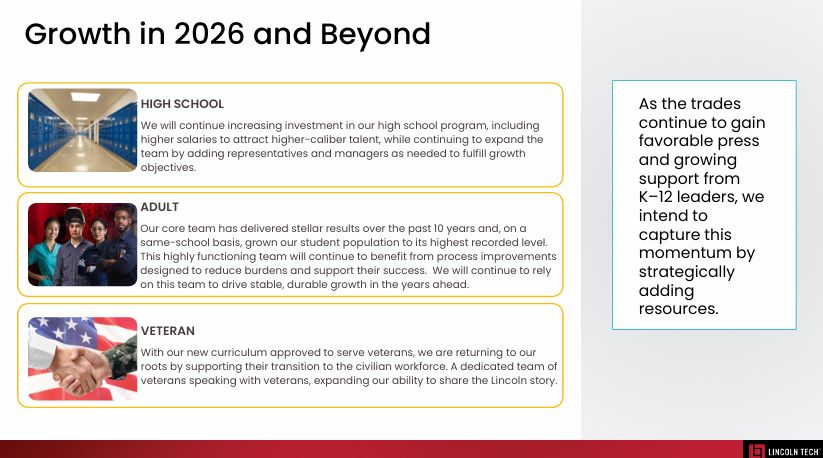
 Growth in 2026 and Beyond  HIGH SCHOOL  We will continue increasing investment in our high school program, including higher salaries to attract higher-caliber talent, while continuing to expand the team by adding representatives and managers as needed to fulfill growth objectives.  ADULT  Our core team has delivered stellar results over the past 10 years and, on a same-school basis, grown our student population to its highest recorded level. This highly functioning team will continue to benefit from process improvements designed to reduce burdens and support their success. We will continue to rely on this team to drive stable, durable growth in the years ahead.  VETERAN  With our new curriculum approved to serve veterans, we are returning to our roots by supporting their transition to the civilian workforce. A dedicated team of veterans speaking with veterans, expanding our ability to share the Lincoln story.  As the trades continue to gain favorable press and growing support from  K–12 leaders, we intend to capture this momentum by strategically adding resources. 
 

 PRESENTED BY: Gina Zaffino  Senior Vice President of Education  March 19, 2026 
 

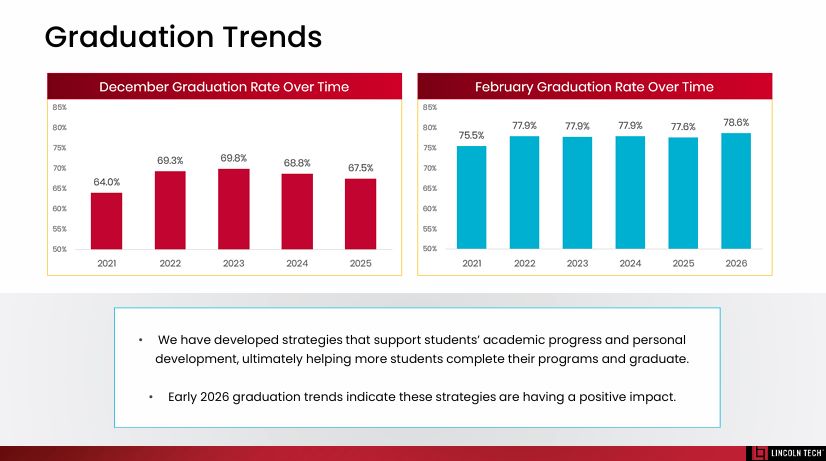
 Graduation Trends   We have developed strategies that support students’ academic progress and personal development, ultimately helping more students complete their programs and graduate.  Early 2026 graduation trends indicate these strategies are having a positive impact. 
 

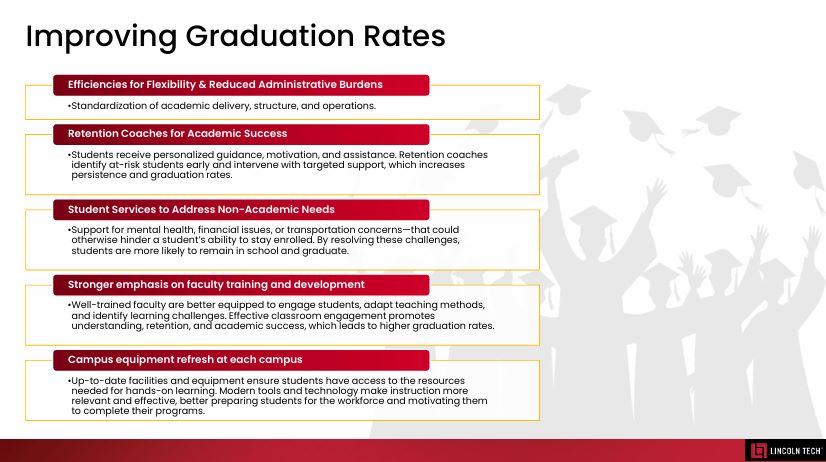
 Improving Graduation Rates  Efficiencies for Flexibility & Reduced Administrative Burdens  Standardization of academic delivery, structure, and operations.  Retention Coaches for Academic Success  Students receive personalized guidance, motivation, and assistance. Retention coaches identify at-risk students early and intervene with targeted support, which increases persistence and graduation rates.  Student Services to Address Non-Academic Needs  Support for mental health, financial issues, or transportation concerns—that could otherwise hinder a student’s ability to stay enrolled. By resolving these challenges, students are more likely to remain in school and graduate.  Stronger emphasis on faculty training and development  Well-trained faculty are better equipped to engage students, adapt teaching methods, and identify learning challenges. Effective classroom engagement promotes understanding, retention, and academic success, which leads to higher graduation rates.  Campus equipment refresh at each campus  Up-to-date facilities and equipment ensure students have access to the resources needed for hands-on learning. Modern tools and technology make instruction more relevant and effective, better preparing students for the workforce and motivating them to complete their programs. 
 

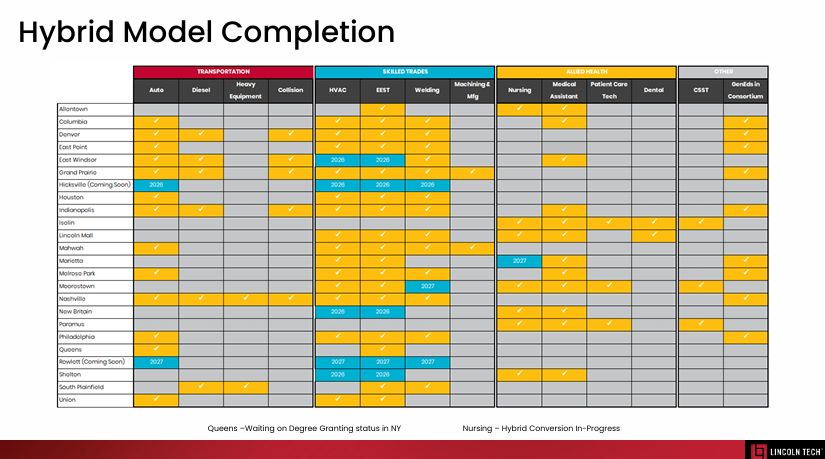
 Queens –Waiting on Degree Granting status in NY  Nursing – Hybrid Conversion In-Progress  Hybrid Model Completion 
 

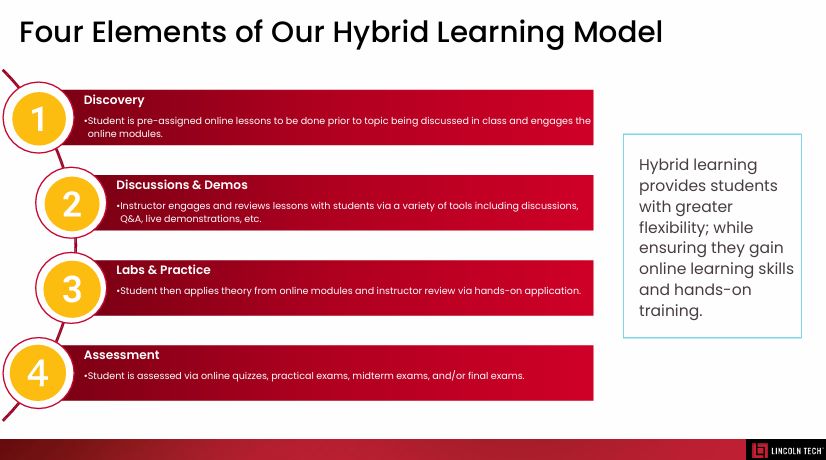
 Four Elements of Our Hybrid Learning Model  Hybrid learning provides students with greater flexibility; while ensuring they gain online learning skills and hands-on training.  Discovery  Student is pre-assigned online lessons to be done prior to topic being discussed in class and engages the online modules.  Discussions & Demos  Instructor engages and reviews lessons with students via a variety of tools including discussions, Q&A, live demonstrations, etc.  Labs & Practice  Student then applies theory from online modules and instructor review via hands-on application.  Assessment  Student is assessed via online quizzes, practical exams, midterm exams, and/or final exams. 
 

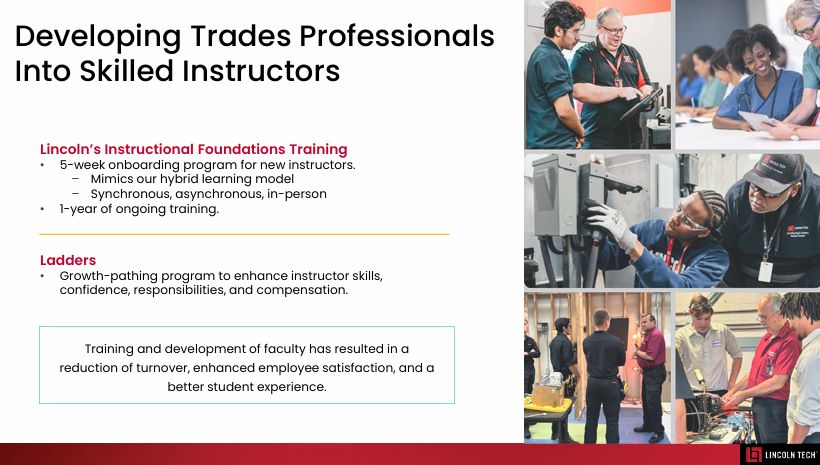
 Developing Trades Professionals Into Skilled Instructors  Lincoln’s Instructional Foundations Training  5-week onboarding program for new instructors.  Mimics our hybrid learning model  Synchronous, asynchronous, in-person  1-year of ongoing training.  Ladders  Growth-pathing program to enhance instructor skills, confidence, responsibilities, and compensation.  Training and development of faculty has resulted in a reduction of turnover, enhanced employee satisfaction, and a better student experience. 
 

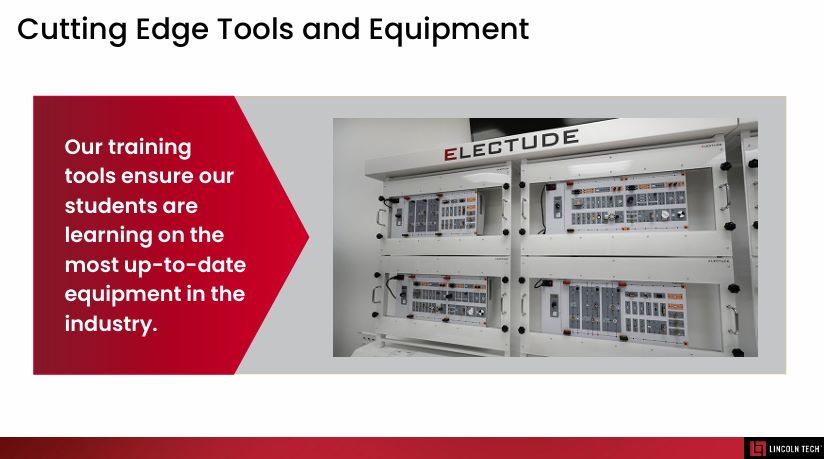
 Cutting Edge Tools and Equipment  Our training tools ensure our students are learning on the most up-to-date equipment in the industry. 
 

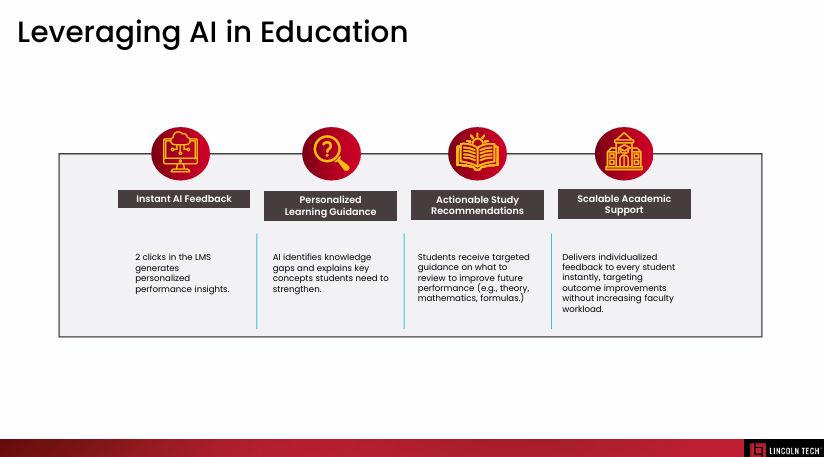
 Leveraging AI in Education  2 clicks in the LMS generates personalized performance insights.  Instant AI Feedback  AI identifies knowledge gaps and explains key concepts students need to strengthen.  Personalized Learning Guidance  Students receive targeted guidance on what to review to improve future performance (e.g., theory, mathematics, formulas.)  Actionable Study Recommendations  Delivers individualized feedback to every student instantly, targeting outcome improvements without increasing faculty workload.  Scalable Academic Support 
 

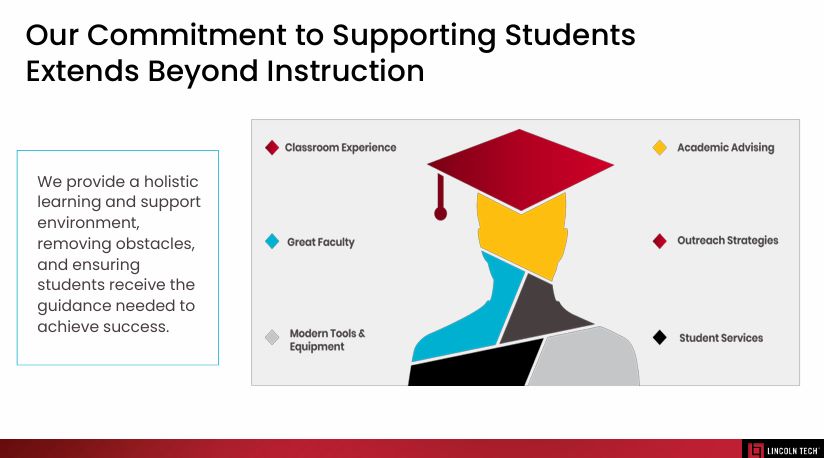
 Our Commitment to Supporting Students Extends Beyond Instruction  We provide a holistic learning and support environment, removing obstacles, and ensuring students receive the guidance needed to achieve success. 
 

 PRESENTED BY: Jennifer Hash  Vice President of Career Services  March 19, 2026 
 

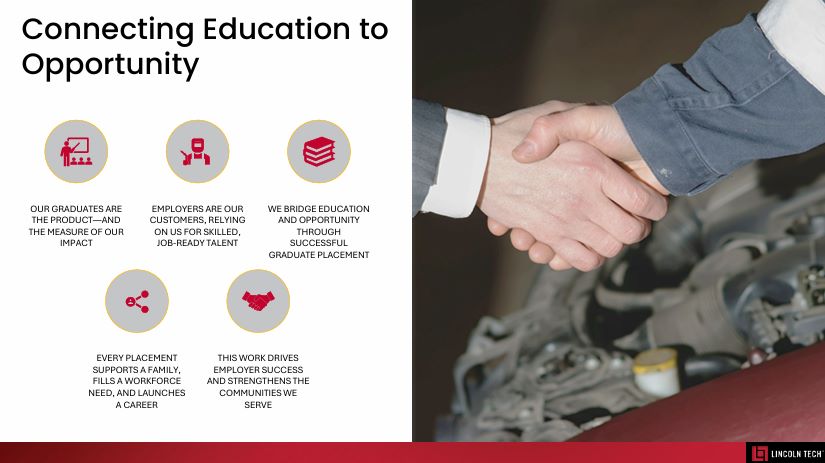
 Connecting Education to Opportunity  OUR GRADUATES ARE THE PRODUCT—AND THE MEASURE OF OUR IMPACT  EMPLOYERS ARE OUR CUSTOMERS, RELYING ON US FOR SKILLED, JOB-READY TALENT  WE BRIDGE EDUCATION AND OPPORTUNITY THROUGH SUCCESSFUL GRADUATE PLACEMENT  EVERY PLACEMENT SUPPORTS A FAMILY, FILLS A WORKFORCE NEED, AND LAUNCHES A CAREER  THIS WORK DRIVES EMPLOYER SUCCESS AND STRENGTHENS THE COMMUNITIES WE SERVE 
 

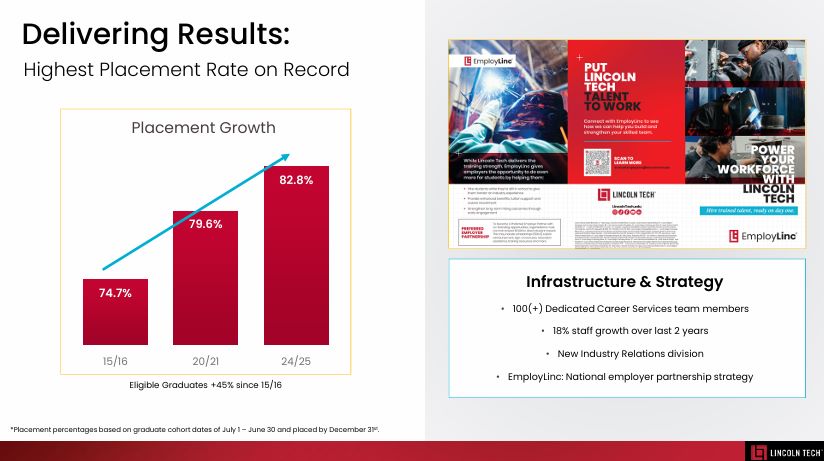
 Delivering Results:  74.7%  82.8%  79.6%  15/16  20/21  24/25  Eligible Graduates +45% since 15/16  *Placement percentages based on graduate cohort dates of July 1 – June 30 and placed by December 31st.  Infrastructure & Strategy  100(+) Dedicated Career Services team members  18% staff growth over last 2 years  New Industry Relations division  EmployLinc: National employer partnership strategy  Highest Placement Rate on Record  Placement Growth 
 

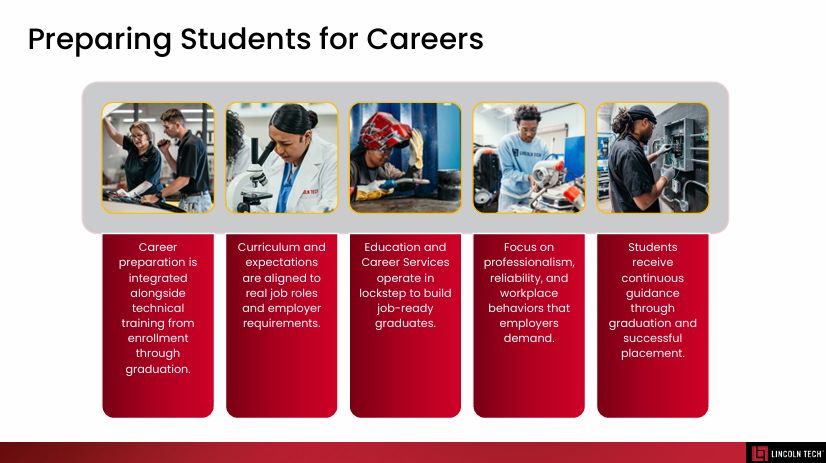
 Preparing Students for Careers  Career preparation is integrated alongside technical training from enrollment through graduation.  Curriculum and expectations are aligned to real job roles and employer requirements.  Education and Career Services operate in lockstep to build job-ready graduates.  Focus on professionalism, reliability, and workplace behaviors that employers demand.  Students receive continuous guidance through graduation and successful placement. 
 

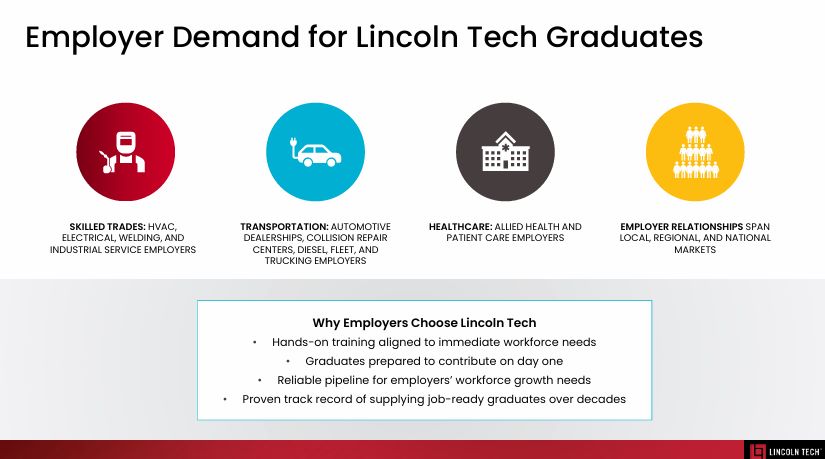
 Employer Demand for Lincoln Tech Graduates  SKILLED TRADES: HVAC, ELECTRICAL, WELDING, AND INDUSTRIAL SERVICE EMPLOYERS  TRANSPORTATION: AUTOMOTIVE DEALERSHIPS, COLLISION REPAIR CENTERS, DIESEL, FLEET, AND TRUCKING EMPLOYERS  HEALTHCARE: ALLIED HEALTH AND PATIENT CARE EMPLOYERS  EMPLOYER RELATIONSHIPS SPAN LOCAL, REGIONAL, AND NATIONAL MARKETS  Why Employers Choose Lincoln Tech  Hands-on training aligned to immediate workforce needs  Graduates prepared to contribute on day one  Reliable pipeline for employers’ workforce growth needs  Proven track record of supplying job-ready graduates over decades 
 

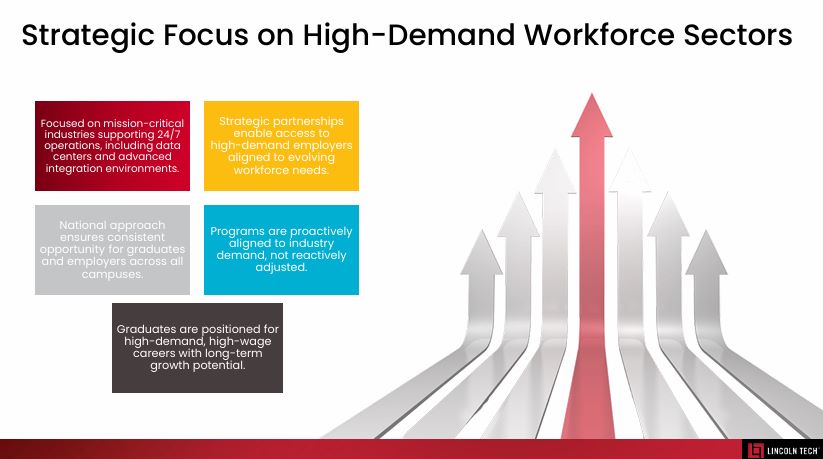
 Strategic Focus on High-Demand Workforce Sectors  Focused on mission-critical industries supporting 24/7 operations, including data centers and advanced integration environments.  Strategic partnerships enable access to  high-demand employers aligned to evolving workforce needs.  National approach ensures consistent opportunity for graduates and employers across all campuses.  Programs are proactively aligned to industry demand, not reactively adjusted.  Graduates are positioned for high-demand, high-wage careers with long-term growth potential. 
 

 PRESENTED BY: Chad Nyce  Executive Vice President and Chief Operating Officer  March 19, 2026 
 

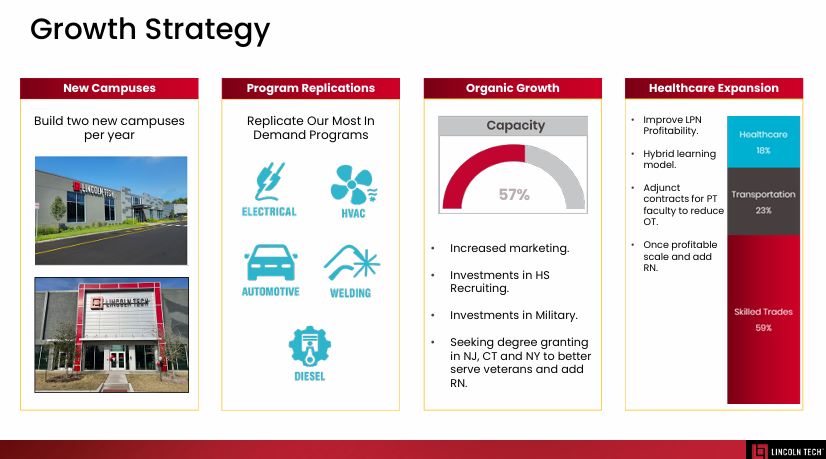
 Growth Strategy  New Campuses  Program Replications  Organic Growth  Healthcare Expansion  Replicate Our Most In Demand Programs  Build two new campuses per year  Increased marketing.  Investments in HS Recruiting.  Investments in Military.  Seeking degree granting in NJ, CT and NY to better serve veterans and add RN.  Improve LPN Profitability.  Hybrid learning model.  Adjunct contracts for PT faculty to reduce OT.  Once profitable scale and add RN.  57% 
 

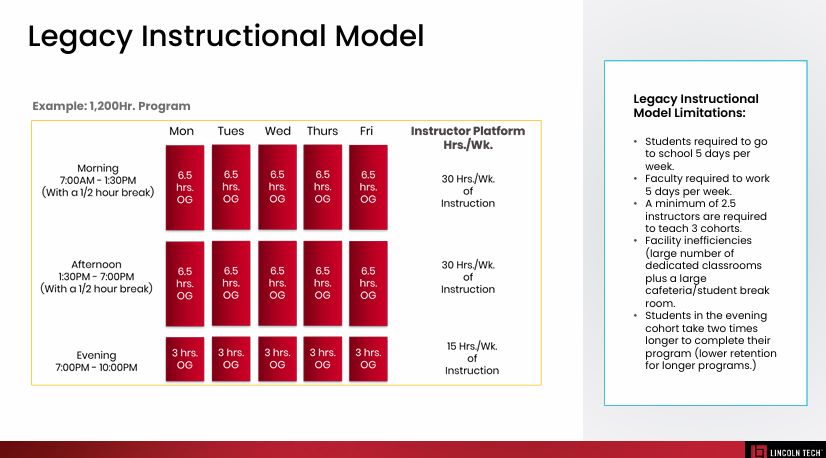
 Legacy Instructional Model  Example: 1,200Hr. Program  Legacy Instructional Model Limitations:  Students required to go to school 5 days per week.  Faculty required to work 5 days per week.  A minimum of 2.5 instructors are required to teach 3 cohorts.  Facility inefficiencies (large number of dedicated classrooms plus a large cafeteria/student break room.  Students in the evening cohort take two times longer to complete their program (lower retention for longer programs.) 
 

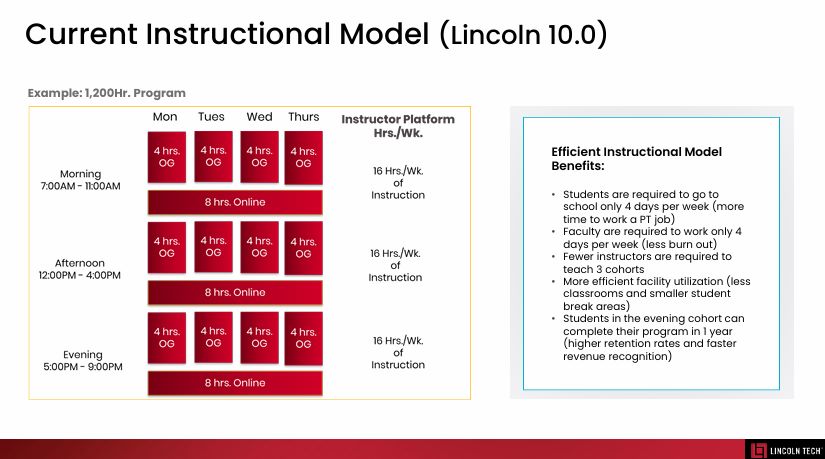
 Current Instructional Model (Lincoln 10.0)  Example: 1,200Hr. Program  Efficient Instructional Model Benefits:  Students are required to go to school only 4 days per week (more time to work a PT job)  Faculty are required to work only 4 days per week (less burn out)  Fewer instructors are required to teach 3 cohorts  More efficient facility utilization (less classrooms and smaller student break areas)  Students in the evening cohort can complete their program in 1 year (higher retention rates and faster revenue recognition) 
 

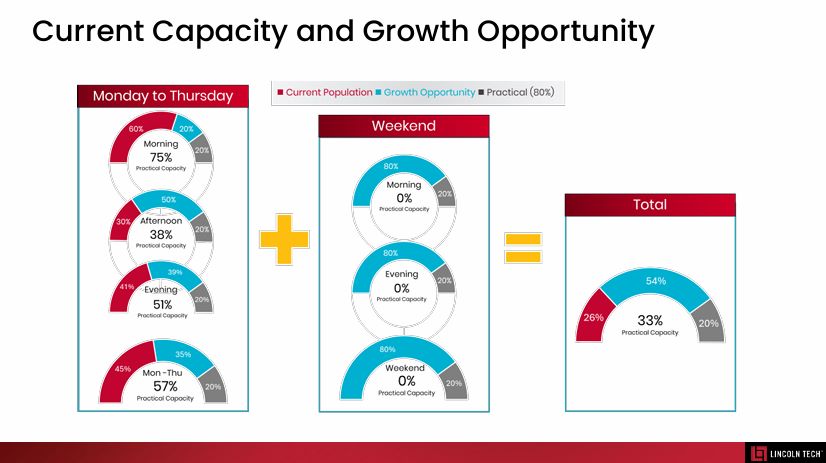
 Current Capacity and Growth Opportunity 
 

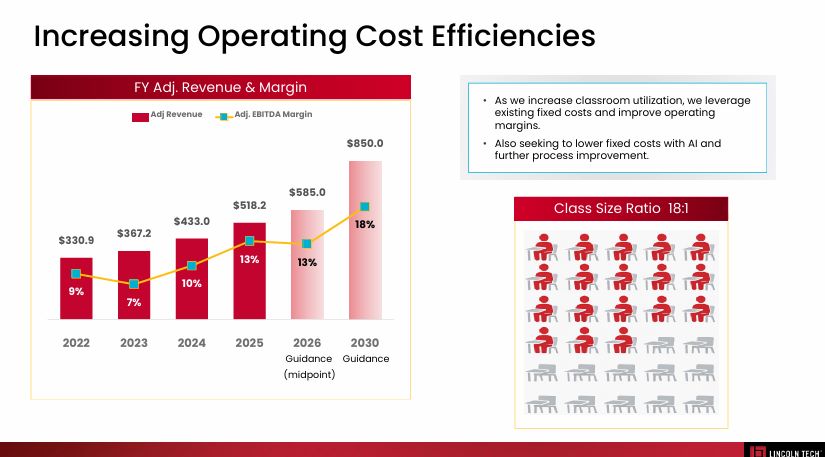
 Increasing Operating Cost Efficiencies  Class Size Ratio 18:1  As we increase classroom utilization, we leverage existing fixed costs and improve operating margins.  Also seeking to lower fixed costs with AI and further process improvement.  $330.9  $367.2  $433.0  $518.2  $585.0  $850.0  9%  7%  10%  13%  13%  18%  2022  2023  2024  2025  FY Adj. Revenue & Margin  Adj Revenue Adj. EBITDA Margin  2026  Guidance (midpoint)  2030  Guidance 
 

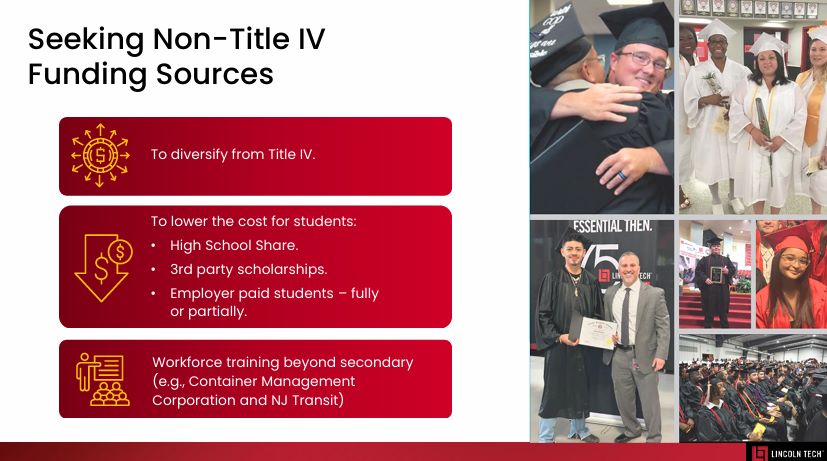
 Seeking Non-Title IV Funding Sources  To diversify from Title IV.  To lower the cost for students:  High School Share.  3rd party scholarships.  Employer paid students – fully or partially.  Workforce training beyond secondary (e.g., Container Management Corporation and NJ Transit) 
 

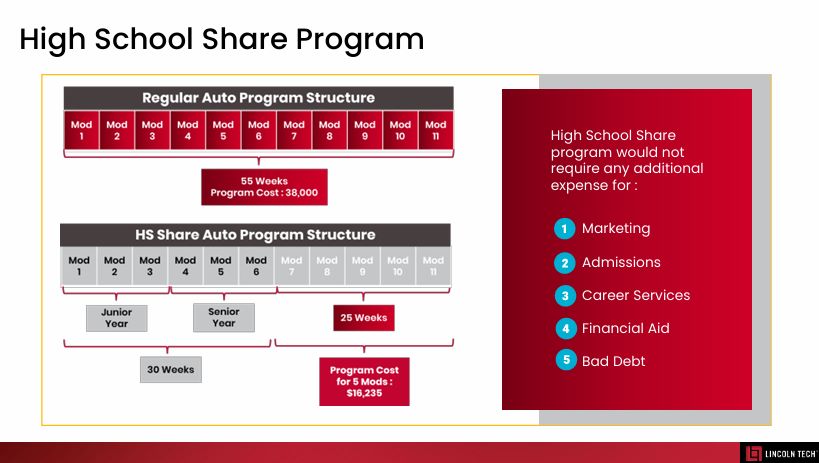
 High School Share Program  High School Share program would not require any additional expense for :  Marketing Admissions Career Services Financial Aid Bad Debt 
 

 PRESENTED BY: Brian Meyers  Executive Vice President and Chief Financial Officer  March 19, 2026 
 

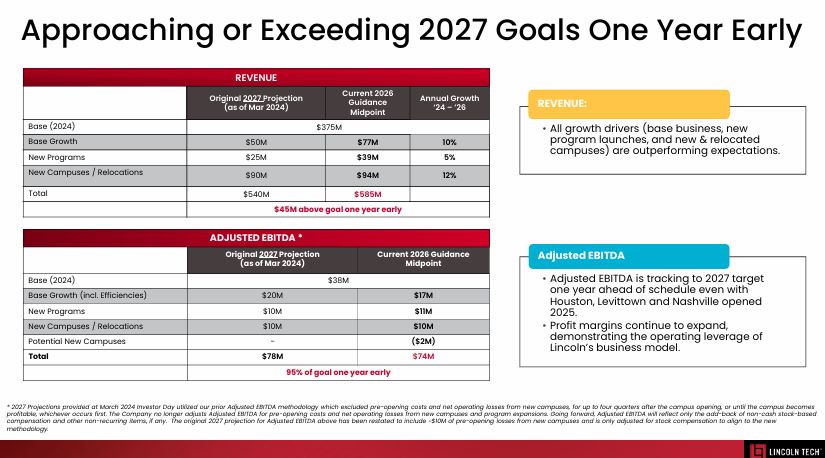
 REVENUE:  All growth drivers (base business, new program launches, and new & relocated campuses) are outperforming expectations.  Adjusted EBITDA  Adjusted EBITDA is tracking to 2027 target one year ahead of schedule even with Houston, Levittown and Nashville opened 2025.  Profit margins continue to expand, demonstrating the operating leverage of Lincoln’s business model.  ADJUSTED EBITDA *  Original 2027 Projection (as of Mar 2024)  Current 2026 Guidance Midpoint  Base (2024)  $38M  Base Growth (incl. Efficiencies)  $20M  $17M  New Programs  $10M  $11M  New Campuses / Relocations  $10M  $10M  Potential New Campuses  -  ($2M)  Total  $78M  $74M  95% of goal one year early  * 2027 Projections provided at March 2024 Investor Day utilized our prior Adjusted EBITDA methodology which excluded pre-opening costs and net operating losses from new campuses, for up to four quarters after the campus opening, or until the campus becomes profitable, whichever occurs first. The Company no longer adjusts Adjusted EBITDA for pre-opening costs and net operating losses from new campuses and program expansions. Going forward, Adjusted EBITDA will reflect only the add-back of non-cash stock-based compensation and other non-recurring items, if any. The original 2027 projection for Adjusted EBITDA above has been restated to include ~$10M of pre-opening losses from new campuses and is only adjusted for stock compensation to align to the new methodology.  REVENUE  Original 2027 Projection (as of Mar 2024)  Current 2026 Guidance Midpoint  Annual Growth ‘24 – ’26  Base (2024)  $375M  Base Growth  $50M  $77M  10%  New Programs  $25M  $39M  5%  New Campuses / Relocations  $90M  $94M  12%  Total  $540M  $585M  $45M above goal one year early  Approaching or Exceeding 2027 Goals One Year Early 
 

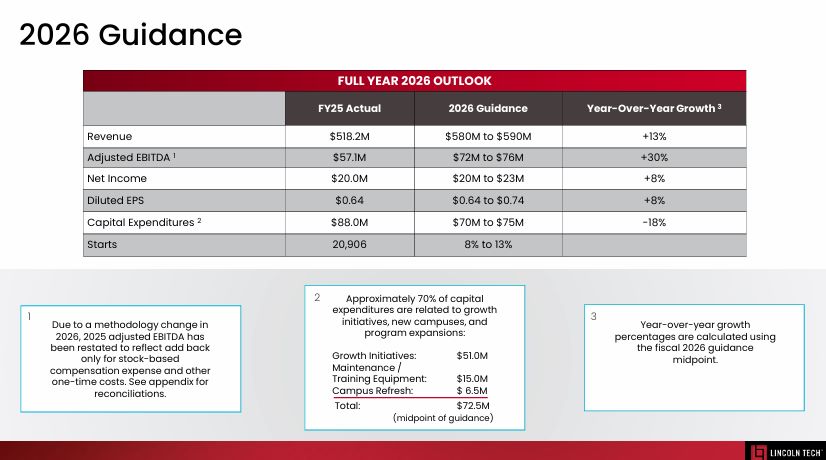
 2026 Guidance  FULL YEAR 2026 OUTLOOK  FY25 Actual  2026 Guidance  Year-Over-Year Growth 3  Revenue  $518.2M  $580M to $590M  +13%  Adjusted EBITDA 1  $57.1M  $72M to $76M  +30%  Net Income  $20.0M  $20M to $23M  +8%  Diluted EPS  $0.64  $0.64 to $0.74  +8%  Capital Expenditures 2  $88.0M  $70M to $75M  -18%  Starts  20,906  8% to 13%  Due to a methodology change in 2026, 2025 adjusted EBITDA has been restated to reflect add back only for stock-based compensation expense and other one-time costs. See appendix for reconciliations.  Year-over-year growth percentages are calculated using the fiscal 2026 guidance midpoint.  Growth Initiatives: $51.0M Maintenance /  Training Equipment: $15.0M  Campus Refresh: $ 6.5M  Total:  $72.5M  (midpoint of guidance)  1  2 Approximately 70% of capital expenditures are related to growth  initiatives, new campuses, and program expansions:  3 
 

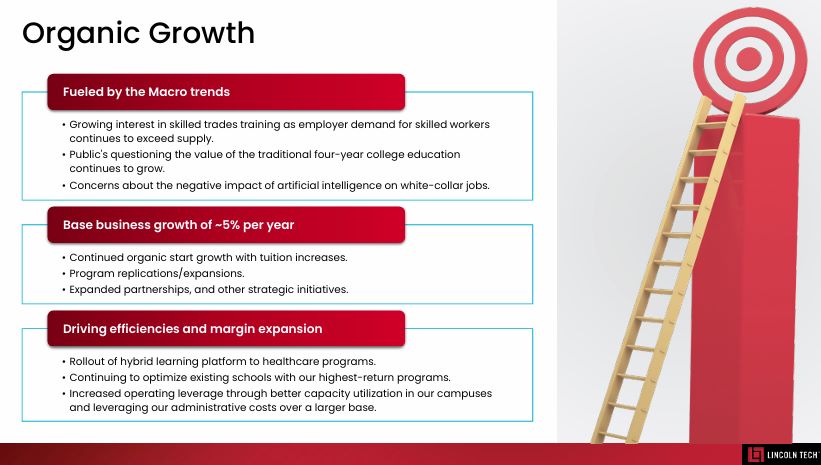
 Organic Growth  Growing interest in skilled trades training as employer demand for skilled workers continues to exceed supply.  Public's questioning the value of the traditional four-year college education continues to grow.  Concerns about the negative impact of artificial intelligence on white-collar jobs.  Fueled by the Macro trends  Base business growth of ~5% per year  Continued organic start growth with tuition increases.  Program replications/expansions.  Expanded partnerships, and other strategic initiatives.  Driving efficiencies and margin expansion  Rollout of hybrid learning platform to healthcare programs.  Continuing to optimize existing schools with our highest-return programs.  Increased operating leverage through better capacity utilization in our campuses and leveraging our administrative costs over a larger base. 
 

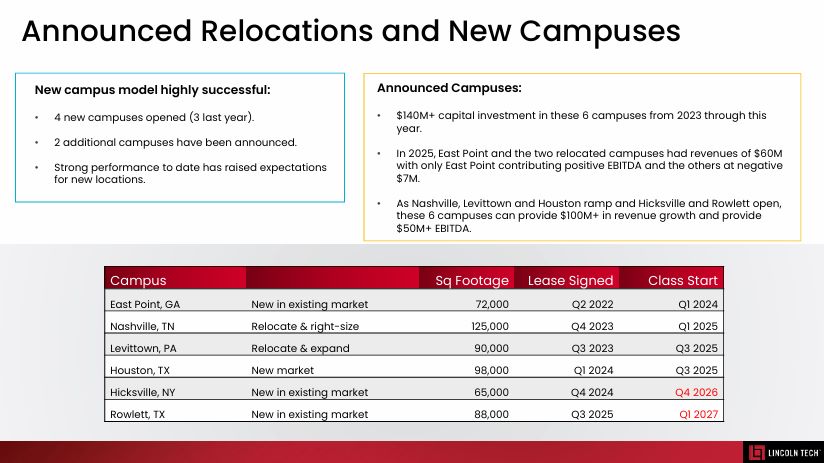
 Announced Relocations and New Campuses  Campus  Sq Footage  Lease Signed  Class Start  East Point, GA  New in existing market  72,000  Q2 2022  Q1 2024  Nashville, TN  Relocate & right-size  125,000  Q4 2023  Q1 2025  Levittown, PA  Relocate & expand  90,000  Q3 2023  Q3 2025  Houston, TX  New market  98,000  Q1 2024  Q3 2025  Hicksville, NY  New in existing market  65,000  Q4 2024  Q4 2026  Rowlett, TX  New in existing market  88,000  Q3 2025  Q1 2027  New campus model highly successful:  4 new campuses opened (3 last year).  2 additional campuses have been announced.  Strong performance to date has raised expectations for new locations.  Announced Campuses:  $140M+ capital investment in these 6 campuses from 2023 through this year.  In 2025, East Point and the two relocated campuses had revenues of $60M with only East Point contributing positive EBITDA and the others at negative  $7M.  As Nashville, Levittown and Houston ramp and Hicksville and Rowlett open, these 6 campuses can provide $100M+ in revenue growth and provide  $50M+ EBITDA. 
 

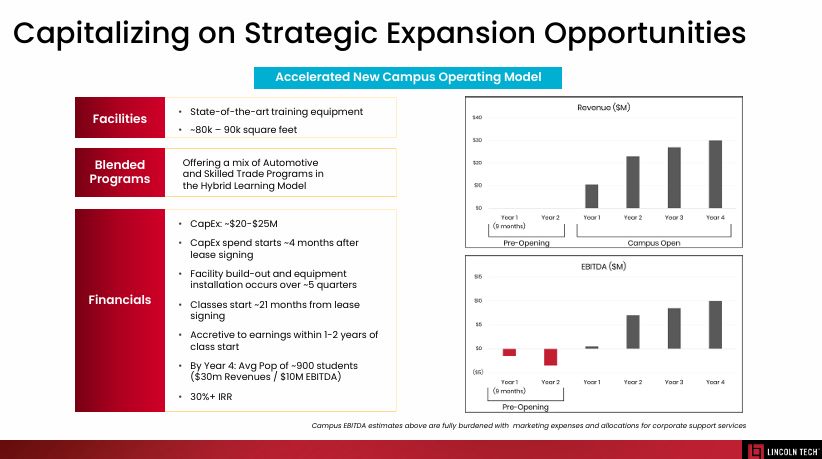
 CapEx: ~$20-$25M  CapEx spend starts ~4 months after lease signing  Facility build-out and equipment installation occurs over ~5 quarters  Classes start ~21 months from lease signing  Accretive to earnings within 1-2 years of class start  By Year 4: Avg Pop of ~900 students ($30m Revenues / $10M EBITDA)  30%+ IRR  Accelerated New Campus Operating Model  Capitalizing on Strategic Expansion Opportunities  Offering a mix of Automotive and Skilled Trade Programs in the Hybrid Learning Model  State-of-the-art training equipment  ~80k – 90k square feet  Campus EBITDA estimates above are fully burdened with marketing expenses and allocations for corporate support services  Facilities  Blended Programs  Financials 
 

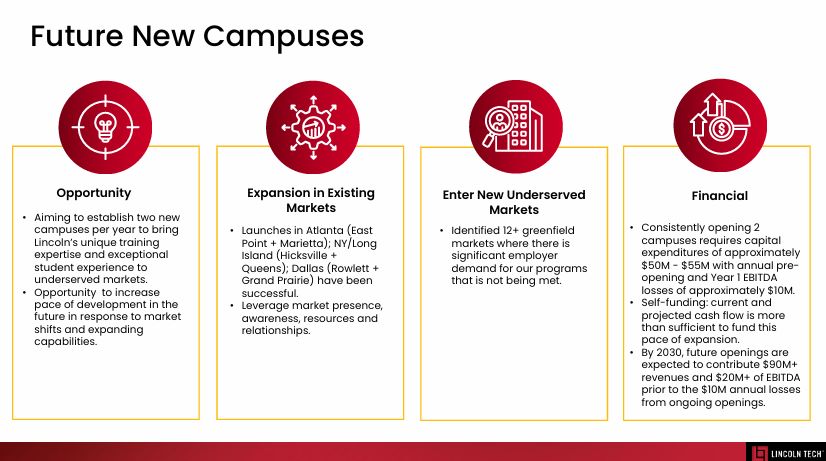
 Future New Campuses  Consistently opening 2 campuses requires capital expenditures of approximately  $50M - $55M with annual pre-opening and Year 1 EBITDA losses of approximately $10M.  Self-funding: current and projected cash flow is more than sufficient to fund this pace of expansion.  By 2030, future openings are expected to contribute $90M+ revenues and $20M+ of EBITDA prior to the $10M annual losses from ongoing openings.  Enter New Underserved Markets  Identified 12+ greenfield markets where there is significant employer demand for our programs that is not being met.  Expansion in Existing Markets  Launches in Atlanta (East Point + Marietta); NY/Long Island (Hicksville + Queens); Dallas (Rowlett + Grand Prairie) have been successful.  Leverage market presence, awareness, resources and relationships.  Opportunity  Aiming to establish two new campuses per year to bring Lincoln’s unique training expertise and exceptional student experience to underserved markets.  Opportunity to increase pace of development in the future in response to market shifts and expanding capabilities.  Financial 
 

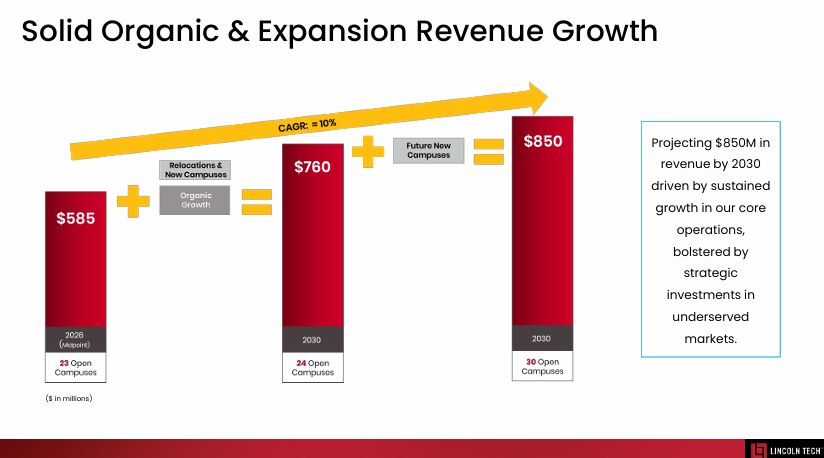
 Solid Organic & Expansion Revenue Growth  Projecting $850M in revenue by 2030 driven by sustained growth in our core operations, bolstered by strategic investments in underserved markets.  ($ in millions) 
 

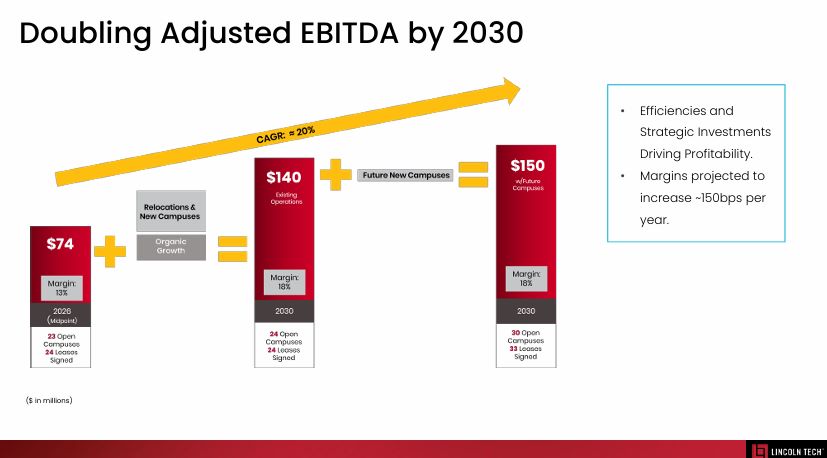
 Doubling Adjusted EBITDA by 2030  Efficiencies and Strategic Investments Driving Profitability.  Margins projected to increase ~150bps per year.  ($ in millions) 
 

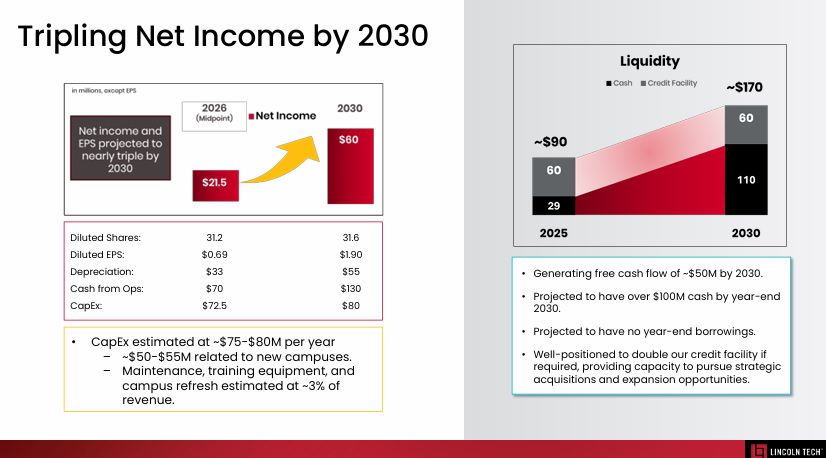
 Tripling Net Income by 2030  Generating free cash flow of ~$50M by 2030.  Projected to have over $100M cash by year-end 2030.  Projected to have no year-end borrowings.  Well-positioned to double our credit facility if required, providing capacity to pursue strategic acquisitions and expansion opportunities.  Diluted Shares:  31.2  31.6  Diluted EPS:  $0.69  $1.90  Depreciation:  $33  $55  Cash from Ops:  $70  $130  CapEx:  $72.5  $80  CapEx estimated at ~$75-$80M per year  ~$50-$55M related to new campuses.  Maintenance, training equipment, and campus refresh estimated at ~3% of revenue. 
 

 PRESENTED BY: SCOTT SHAW  Chief Executive Officer and President  March 19, 2026 
 

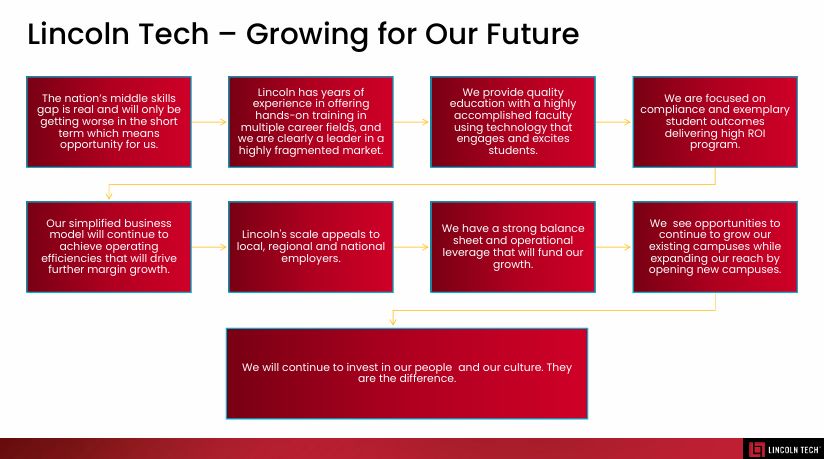
 The nation’s middle skills gap is real and will only be getting worse in the short term which means opportunity for us.  Lincoln has years of experience in offering hands-on training in multiple career fields, and we are clearly a leader in a highly fragmented market.  We provide quality education with a highly accomplished faculty using technology that engages and excites students.  We are focused on compliance and exemplary student outcomes delivering high ROI program.  Our simplified business model will continue to achieve operating efficiencies that will drive further margin growth.  Lincoln's scale appeals to local, regional and national employers.  We have a strong balance sheet and operational leverage that will fund our growth.  We see opportunities to continue to grow our existing campuses while expanding our reach by opening new campuses.  We will continue to invest in our people and our culture. They are the difference.  Lincoln Tech – Growing for Our Future 
 

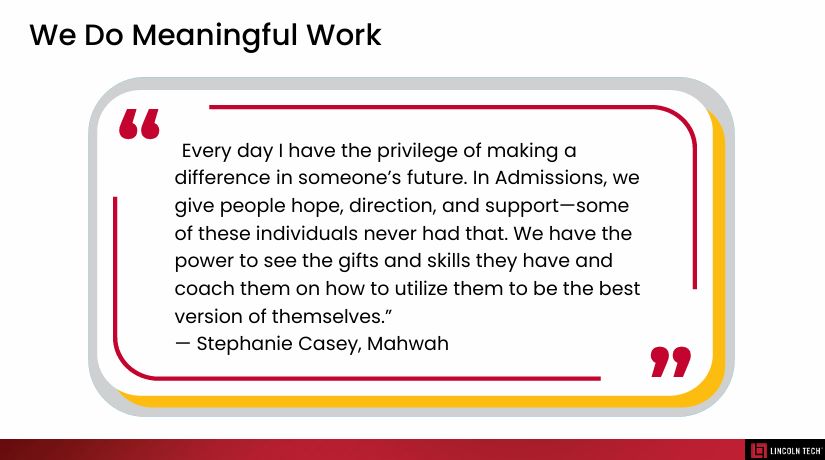
 We Do Meaningful Work  Every day I have the privilege of making a difference in someone’s future. In Admissions, we give people hope, direction, and support—some of these individuals never had that. We have the power to see the gifts and skills they have and coach them on how to utilize them to be the best version of themselves.”  — Stephanie Casey, Mahwah 


 Appendix 
 

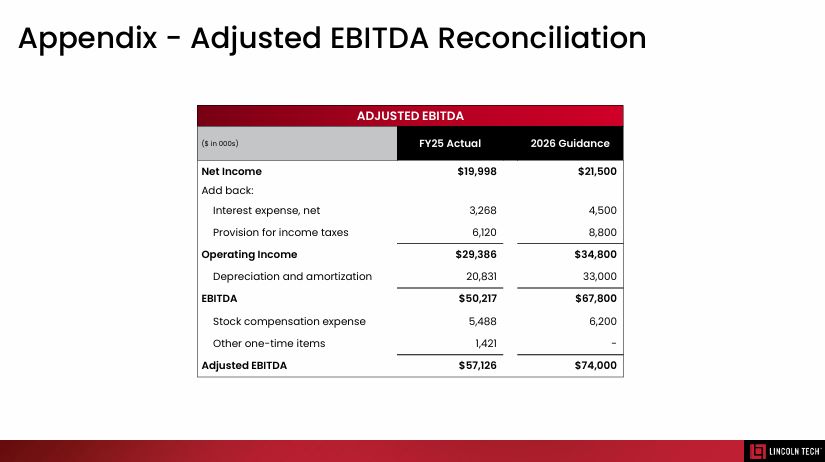
 ADJUSTED EBITDA  ($ in 000s)  FY25 Actual  2026 Guidance  Net Income  $19,998  $21,500  Add back:  Interest expense, net  3,268  4,500  Provision for income taxes  6,120  8,800  Operating Income  $29,386  $34,800  Depreciation and amortization  20,831  33,000  EBITDA  $50,217  $67,800  Stock compensation expense  5,488  6,200  Other one-time items  1,421  -  Adjusted EBITDA  $57,126  $74,000  Appendix - Adjusted EBITDA Reconciliation